2023.5.22 pf. KSH
2025.11.24 pf. KSH
Photon radiant energy exiting the linac target
- 70% primary photon energy
- Estimation이 상대적으로 정확하게 가능.
- 30% head scatter photon energy
- RTP 관점에서 이걸 얼마나 정확하게 계산해서 반영하는지가 중요하다.
10.1 Dose calculation parameters
Source와 환자 사이의 거리, 몸에서의 깊이, surface 면적 등이 MU 계산에 사용 될 것.
Primary component
Dose in a hypothetical 0x0 field.
For MV photon beam, it is reasonable to consider collimator scatter as part of the primary beame so that the phantom scatter could be calculated separately.
CT를 찍지 않고 바로 MU값을 구하고자 한다면 이런걸 쓰게 됨. 요즘은 RTP로 대신 하다보니 이런걸 잘 안씀.
Phantom 내에서 primary dose는 어떻게 구할까?
3×3 or 4×4 등에서 측정한 값을 가지고 0x0에서의 값으로 extrapolation하여 estimation.
본원에서는 Acuros xb algorithm을 사용.
Scatter component
Effective primary dose = Primary + C.S.
A. Collimator scatter (C.S.)
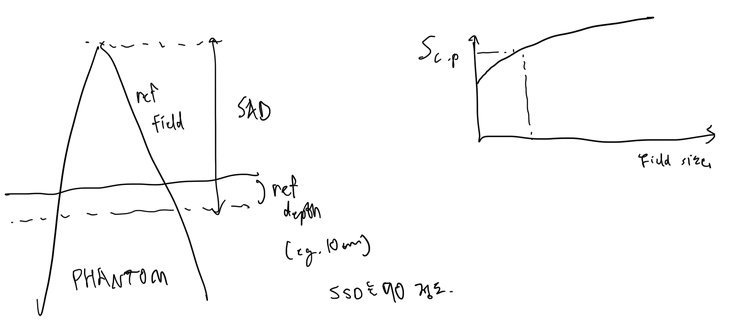
- Field size가 가장 중요하다. Field size가 증가하면 공기중에 측정 된 beam의 output이 증가하게 된다. 기준은 10×10.
- Collimator scatter factor (S_c)
- 보통은 water phantom에 넣고 측정하지만, phantom이 없는 상황에서 구한다. Phantom의 영향을 없애고 싶으면 air에서 build up cap을 씌우고 측정. lateral margin이 충분해야 한다. Reference field (10×10)에서 측정된 값과 비교한 ratio를 이용하여 구함.
- A lateral margin of at least 1cm between the field edgeg and the buildup cap is considered adequate
- Normally, SSD를 이용하여 측정
- Output factor(S_c,p), S_c, S_p를 나눠서 계산 ← Sc를 이용하여 S_p factor를 구할 수 있다.
- Phantom을 함께 고려하는 것은, output factor를 측정해서 elipse가 MU 계산을 할 수 있도록 값을 쥐어 줌.
- Electro contamination을 방지하기 위해 miniphantom 사용.
B. Phantom scatter (P.S.)
- Phantom 내부에서 발생하는 scatter 이므로 effective primary dose에는 포함되지 않는다.
- lateral equilibrium이 중요 함
- Phantom scatter factor (S_p)
- E.g. TBI (40×40) 에서도 각 장기마다 scatter portion은 구성하는 물질에 따라 달라질 수 있다. 이런걸 고려하기 위해.
- S_p may be defined as ther atio of the dose rate (or MU) @10×10
- S_p is related to the changes in the volume of the phantom irradiated for a fixed collimator opening.
- S_p = output factor(S_c,p) / S_c
C. Tissue-phantom ratio and tissue-maximum ratio
Tissue phantom ratio (TPR)
- Defined as the ratio of the dose rate at a given depth in phantom to the dose rate at the same source point distance, but at reference depth
- SAD가 같은 경우 동일한 값을 가진다(?)
- Depend on energy, depth, field size
- Independent on SSD (Same eproperty as TAR)
- ⭐️If D_max is adopted as a fixed reference depth, the quantity TPR give rise to the TMR.
C.1. Relationship between TMR and PDD
- TPR and TAR makes all these funcitons practically independent of SSD
Reference depth에서 peak를 찍음. 이 때 까지는 거의 동일하다. SSD가 커지면 좀 더 천천히 감소하는 모습을 보임 - PDD(d, r, f) = D1/D0 * 100
TPR (d, rd) = D1/D2 = PDD(d,r,f) * D0 / 100 * D2
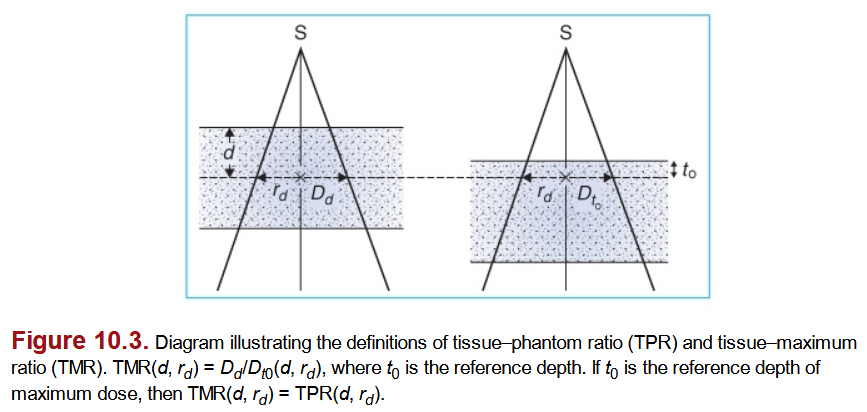
위는 SAD가 고정되어있는 상태에서의 TPR & TMR diagram. TMR은 D max 지점.
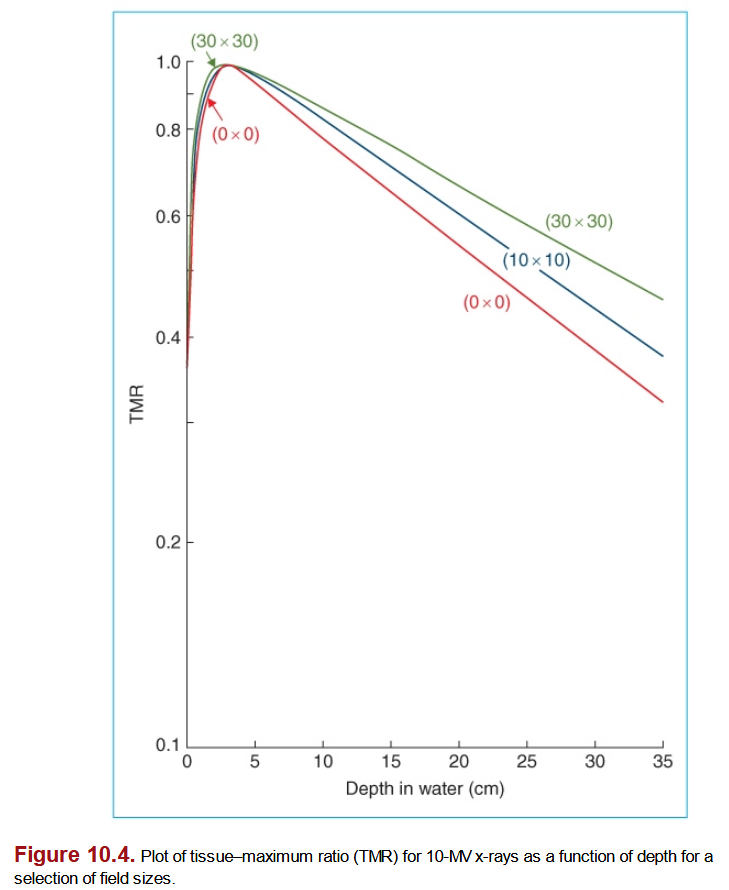
C.1. Relationship between TMR and PDD
D. SPR and SMR
Scatter maximum ratio (SMR)은 요새 굳이 따지진 않는 듯.
10.2 Formalism for the calculation of MU
TBI sheet를 좀 보다 보면 MU 계산에 대한 내용, dose calibration 관련 내용들을 볼 수 있다. (e.g., k 값 등등)
A. General equations
MU 계산식. 얼마만큼의 dose를 특정 point에 조사할 것인가
선형가속기에서는 1MU가 어떤 조건에서 calibration되어있는가.
이제 본원에서는 CT sim 후 TPS?에서 계산한다.
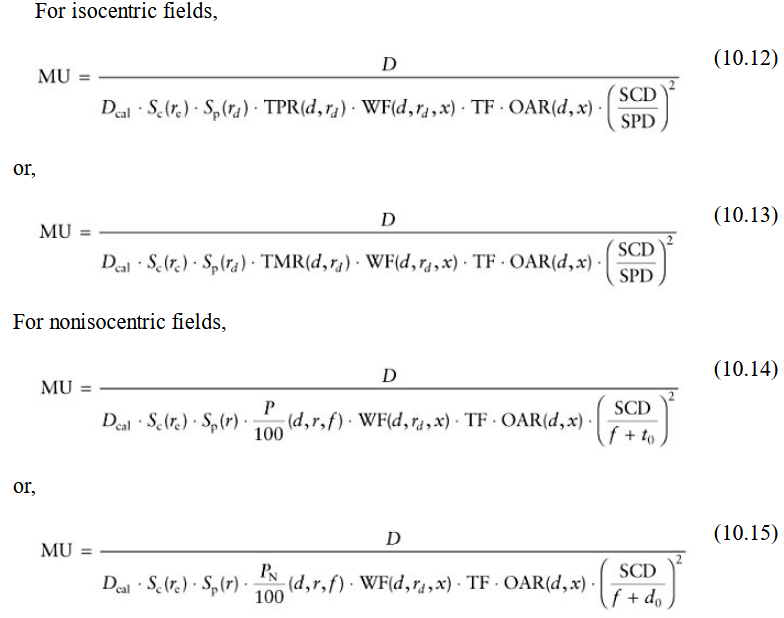
D = dose to be delivered at the point of interest;
Dcal = Calibration dose per MU at dref under reference conditions;
Sc(rc) = Collimator scatter factor for the collimator-defined field size rc;
Sp(r) = Phantom scatter factor at dref for the field size r at the surface;
Sp(rd) = Phantom scatter factor at dref for the field size rd at depth d;
WF(d,rd,x) = Wedge factor at depth d, field size rd, and off-axis distance x;
TF = Tray factor (block을 tray에 붙인다);
OAR(d,x) = Off-axis ratio at depth d and off-axis distance x; (center에서 lateral로 이동하게 되면 고려해야 하는 부분)
SCD = Source to calibration point distance at which Dcal is specified;
SPD = Source to point of interest distance at which D is delivered;
d0 = dref for TPR and PDDN;
t0 = dref of maximum dose for TMR and PDD.
The above MU equations assume that:
- The calibration dose per MU, Dcal, is specified at the source-calibration point
distance, SCD, for the reference field size and at the reference depth. - dref for Dcal and Sp is the same as for the respective dosimetric quantity (TPR, TMR,
PDD, or PDDN) in conjunction with which they are used. - Tray factor, TF, is a transmission factor for the blocking tray, independent of field
size and depth. - Inverse square law holds good for change in photon energy fluence in air as a
function of distance from the source.
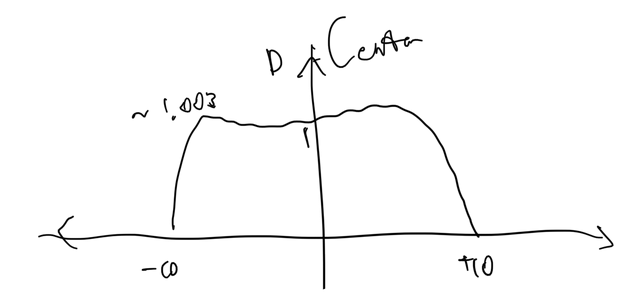
- Inverse square law
- SCD: source to callibration distance
- SPD: source to point of intereset distance
Non-isocentric center라면?
B. Irregular fields
Clarkson(?) method: SAR를 sector 별로 구분해서 계산하는 방법
C. Asymmetric fields
10.3 Other practical mothods of calculating depth dose distribution
이런게 있구나 읽어만 보기
A. Approximation of irregular fields
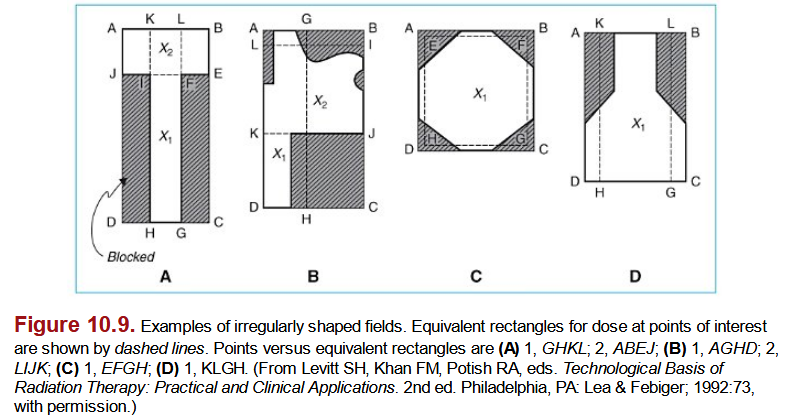
요즘은 이런식으로 계산하지 않고 CT sim
B. Point Off-axis
- 거의 쓰진 않음.
- Day’s method
→ 임상에선 field를 벗어나면 계산을 하지 않고 측정을 하게 된다. 잘 안 쓰는 방법.