Introduction
Epidemiology and etiology
15~34?? 50?? ???? Bimodal peak. Nodular sclerosis type? ????? ????? ? ??.
WHO classification
- Nodular lymphocyte predominant Hodgkin�s lymphoma
- Classical Hodgkin�s lymphoma
- Nodular sclerosis (50%)
- Enlarging cervical or mediastinal lymph node in a young adult, usually female.
- Lymph node is divided by bands of sclerosis; RS cells are present in lake-like spaces
- Lymphocyte-rich (15%, ?? ?? ??)
- Mixed cellularity (40%)
- Often associated with abundant eosinophils (RS cells produce IL-5)
- Lymphocyte-depleted (<10%, ?? ?? ??)
- Nodular sclerosis (50%)
Approach to the patient
Clinical features
- B symptom; fever, chills and night sweats
- Pel-Epstein fever
- ??~??? ?? ??? ????…
- Pain in areas of lymphadenopathy following exposure to small quantities of alcohol
- May be d/t vasodilation in the LN following alcohol exposure causing capsular distension.
Lab findings
- ?LDH
- Eosinophilia
- Tumor cells secrete cytokines that generate eosinophils
- Peripheral blood smear (PBS)
- Neoplastic proliferation of Reed-Sternberg (RS) cells, which are large B cells with multi-lobed nuclei and prominent nucleoli (‘owl-eyed nuclei’)
RS(Reed-Sternberg) cell

CD15+, CD30+ B cell origin.
Secrete cytokines;
Attract reactive lymphocytes, plasma cells, macrophages, and eosinophils
May lead to fibrosis
Imaging
- PET scan with 18-FDG
- Imaging test of choice.
Classification
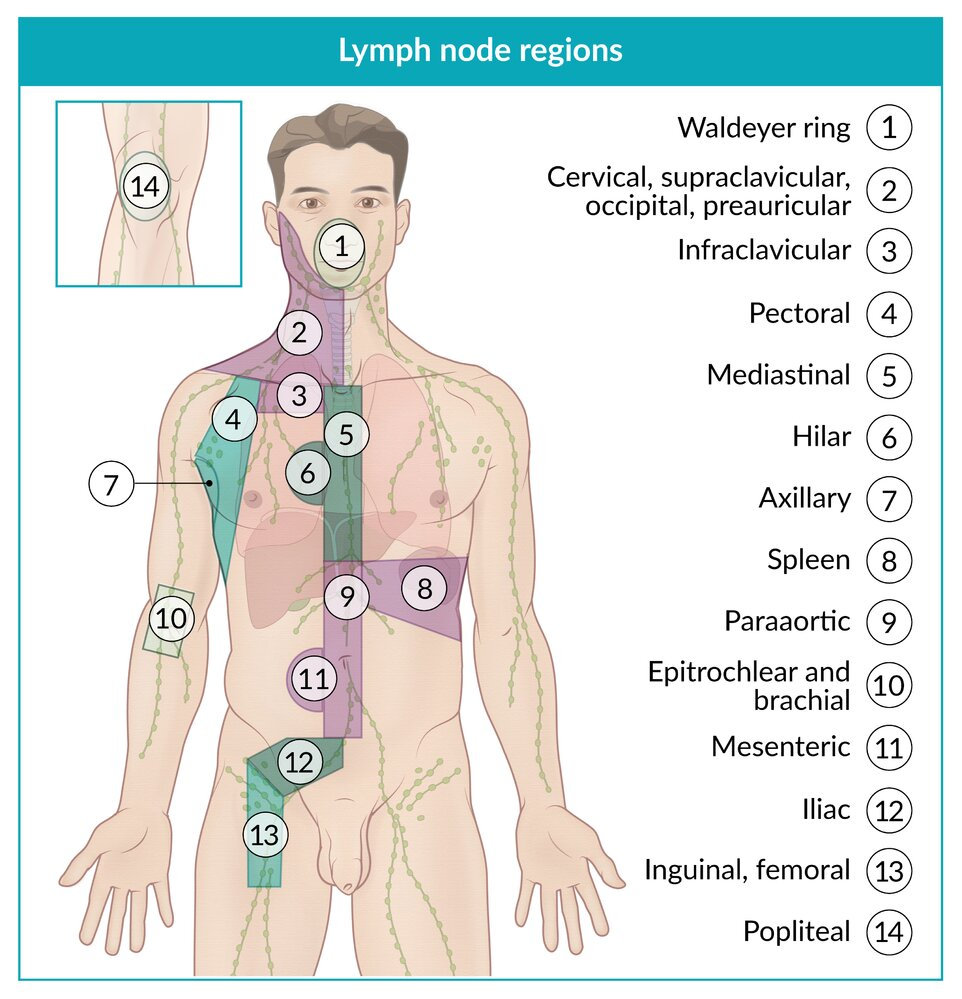

Risk factors
Unfavorable prognostic factors for limited-stage HL
- High ESR, high LDH, B symptoms
- Involvement of >3 LN areas or ≥1 extranodal site
- Bulky disease
- Age ≥ 50 years
International prognostic score (IPS) for advanced-stage HL
- Hypoalbuminemia (<4g/dL)
- Hb <10.5g/dL
- Male sex
- Age ≥45 years
- Lugano classification stage IV
- WBC ≥ 15,000/mm3
- Lymphopenia: lymphocyte count <8% or absolute lymphocyte count <600 cells/mm3
Treatment
Classic Hodgkin’s lymphoma
Early stage disease

Localized or good-Px disease: brief course CTx + followed RTx to involved node site
- ABVD
- Adriamycin(doxorubicin)
- Bleomycin
- Vinbalstine
- Dacarbazine
- MOPP
- Mechlorethamine(nitrogen mustad)
- S/E: Infertility
- Oncovin (Vincristine)
- Procabazine
- Prednisone
- Mechlorethamine(nitrogen mustad)
Advanced stage disease
Relapsed disease
Survivorship
Combination of CTx and RTx cures >75% of cases.
More patients died from late complications of therapy than from HL itself, particularly with localized disease.
Long-term complications
- Second malignancies
- Acute leukemia in the first 10 yrs
- Risk: MOPP-like, BEACOPP-like > ABVD
- Solid organ carcinomas ?10 years after treatment
- Associated with use of radiotherapy
- Acute leukemia in the first 10 yrs
- Cardiac injury
- Risk of coronary artery disease, valve damage, peripheral. vascular disease, and cardiomyopathy
- Pulmonary disease
- Radiation-induced fibrosis
- 4-24 months after therapy
- Dyspnea, nonproductive cough, and chest pain
- Chest x-ray: volume loss with coarse opacities
- Bronchiectasis
- Radiation-induced fibrosis
- Hypothyroidism
- Neuropathy
- d/t chemotherapy
Nodular lymphocyte-predominant Hodgkin lymphoma
Prognosis
Overall, good prognosis with a 5ySR 80-90% (in children, >95%)
- Lymphocyte-rich cHL (LRHL) – best prognosis
- Nodular lymphocyte predominant HL (NLPHL) – good prognosis
- Lymphocyte-depleted HL (LDHL) – poor prognosis
There is an increased risk for treatment-related second malignancies. (e.g., breast, lung, colorectal).