1 THE DEPOSITION OF RADIATION ENERGY
- – radiation is absorbed in biologic material → ionizations and excitations occur
- – not distributed at random but tend to be localized along the tracks of individual charged particles
- – depends on the type of radiation involved
- – spatial distribution of ionization events produced by different particles varies (Fig 7.1.)
- 1) sparsely ionizing
- – χ-and γ-rays
- – ionizing events are well separated in space
- 2) densely ionizing
- – α-particles and neutrons
- – dense columns of ionization
2 LINEAR ENERGY TRANSFER
– definition : energy transferred per unit length of the track (keV/μm)
L = dE/dl
(L; linear energy transfer
dE ; the average energy locally imparted to the medium by a charged particle of specified energy
dl ; traversing distance)
– LET is the average energy deposited per unit length of track (Fig 7.2)
- 1) track average
- – obtained by dividing the track into equal lengths
- – calculating the energy deposited in each length
- 2) energy average
- – obtained by dividing the track into equal energy increments and averaging the lengths of track
– LET is useless and very misleading in some circumstances, but is useful as a simple and naive way to indicate the quality of different types of radiation
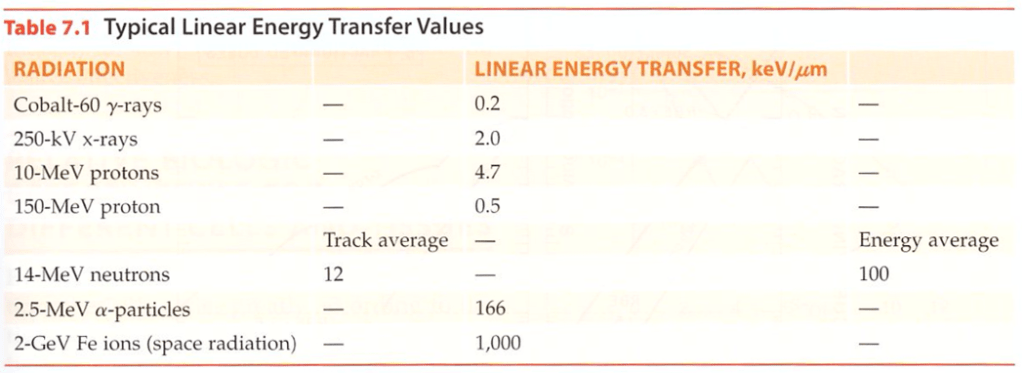
– for a given type of charged particle, the higher the energy, the lower the LET and therefore the lower its biologic effectiveness (Table 7.1.)
3 RELATIVE BIOLOGIC EFFECTIVENESS
- – absorbed dose : term of amount or quantity of radiation (unit : gray or rad)
- – a measure of the energy absorbed per unit mass of tissue
- – equal doses of different type of radiation do not produce equal biologic effects
- – difference : pattern of energy deposition at the microscopic level
- – RBE (relative biologic effectiveness) : some test radiation compared with x-rays (x-ray as standard)
- i.e.) D250/Dr = X-ray dose / tested
- D250; doses of 250-kV x-rays
- Dr; dose of the test radiation(r) required for equal biologic effect
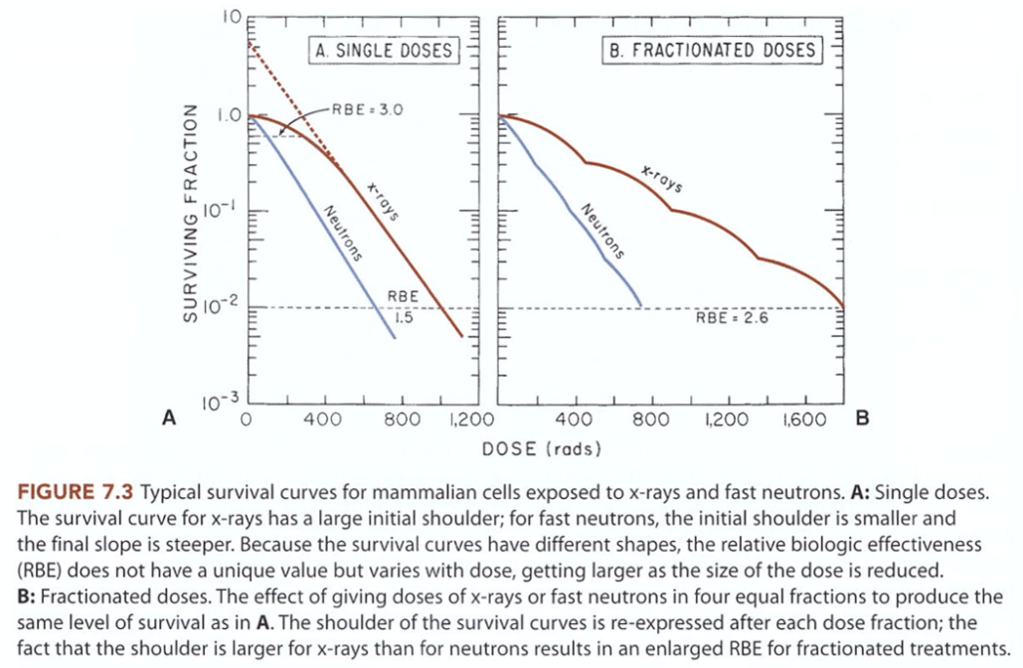
- study of RBE differs according to the endpoint (Fig. 7.3)
- fast neutron, 250-kV x-rays, mammalian cells
- surviving fraction of 0.01 : RBE=1.5
- surviving fraction of 0.6 : RBE=3.0
- RBE는 dose가 작아질수록 커지는 경향이 있다. fractionation하는 경우에는 그렇지 않은 경우보다 크다.
- endpoint에 따라 RBE가 다르기 때문에, endpoint를 가지고 얘기해야 한다. 매우 중요!
- fast neutron, 250-kV x-rays, mammalian cells
- because the x-ray and neutron survival curves have different shapes (shoulder), the RBE depends on the level of biologic damage chosen
- generally, dose ↓ → RBE ↑
4 RELATIVE BIOLOGIC EFFECTIVENESS AND FRACTIONATED DOSES
- RBE for a fractionated regimen with neutrons is greater than for a single exposure (because fractionated schedule consists of a number of small doses → the RBE is large for small doses)
- Fig 7.3B
- surviving fraction of 0.01 ; RBE=2.6 (> Fig 7.3A)
- → this is a direct consequence of the larger shoulder of the x-ray, repeated for each fraction
- neutrons become progressively more efficient than x-rays as the dose per fraction is reduced and the number of fraction is increased
5 RELATIVE BIOLOGIC EFFECTIVENESS FOR DIFFERENT CELLS AND TISSUES
- RBE varies greatly according to the tissue or endpoint studied
- cells characterized by x-ray survival curve with large shoulder larger RBEs for neutrons
- cells characterized by x-ray survival curve with little shoulder smaller RBEs for neutrons
6 RELATIVE BIOLOGIC EFFECTIVENESS AS A FUNCTION OF LET
(Fig 7.4) LET↑ → survival curves become steeper, shoulder of the curve becomes smaller
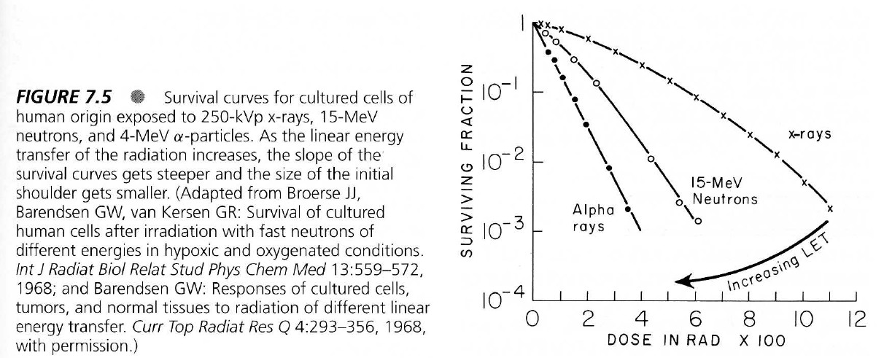
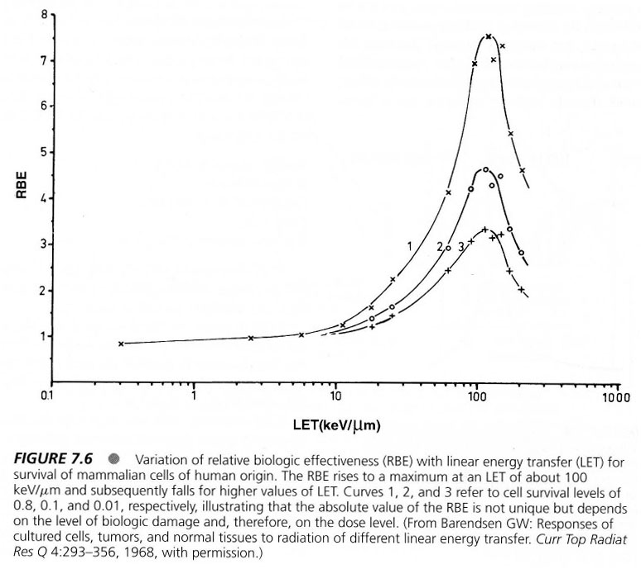
Fig 7.5) LET↑ → RBE increases slowly at first
→ more rapidly increased beyond 10keV/μm
→ rapidly increased between 10 and 100keV/μm (maximum at 100keV/μm)
→ beyond this value → RBE falls to lower values
7 THE OPTIMAL LINEAR ENERGY TRANSFER
왜 100keV/mL LET에서 가장 RBE가 클까? 아래 설명은 절대적인 사실은 아니고 유력한 가설임.
- – why radiation with an LET of about 100keV/μm is optimal (Fig 7.6.)
- – at this density of ionization, the average separation between ionizing events just about coincides with the diameter of the DNA double helix (2nm) → highest probability of causing a double-strand break
- – the most biologically effective LET is that at which there is a coincidence between the diameter of the DNA helix and the average separation of ionizing events
8 FACTORS THAT DETERMINE RELATIVE BIOLOGIC EFFECTIVENESS
RBE depends on the following
– Radiation quality (LET)
– Type of radiation and its energy
– Radiation dose
– Number of dose fractions
– Dose rate
– Biologic system or endpoint
9 THE OXYGEN EFFECT AND LINEAR ENERGY TRANSFER
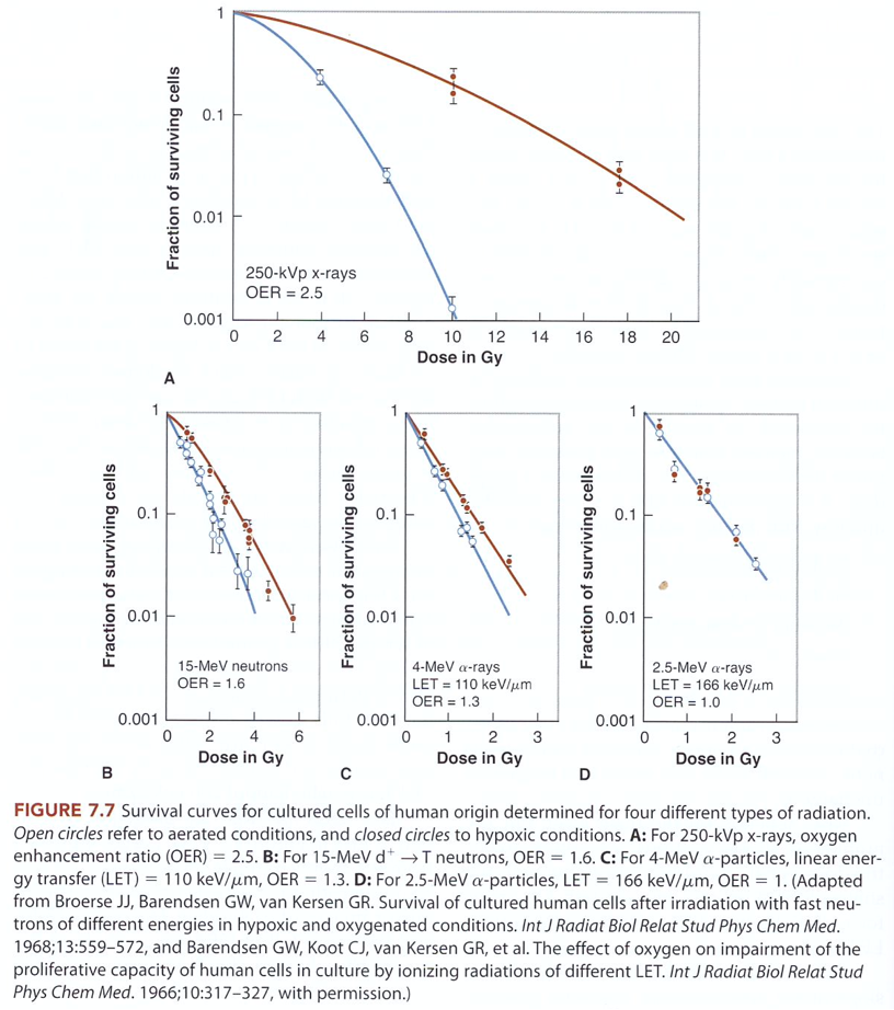
Important relationship between LET and the OER (Fig 7.7.)
– mammalian cell survival curves for various types of radiation
– very different LETs and OERs
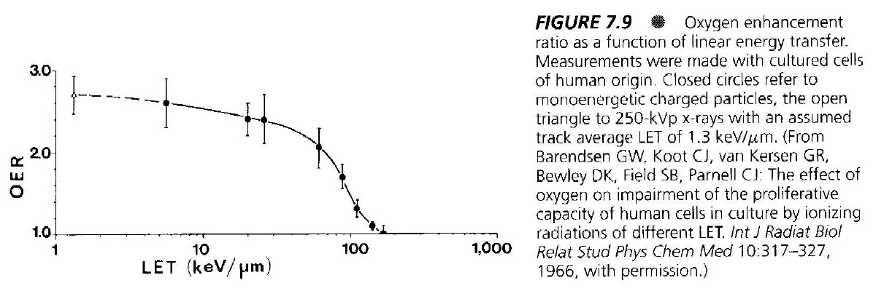
OER as a function of LET (Fig 7.8)
– at low LET (x-ray, γ-ray) : OER is between 2.5 and 3
– as LET increases : OER falls slowly at first
– after LET 60 keV/μm; OER falls rapidly and reaches unity about 200keV/μm
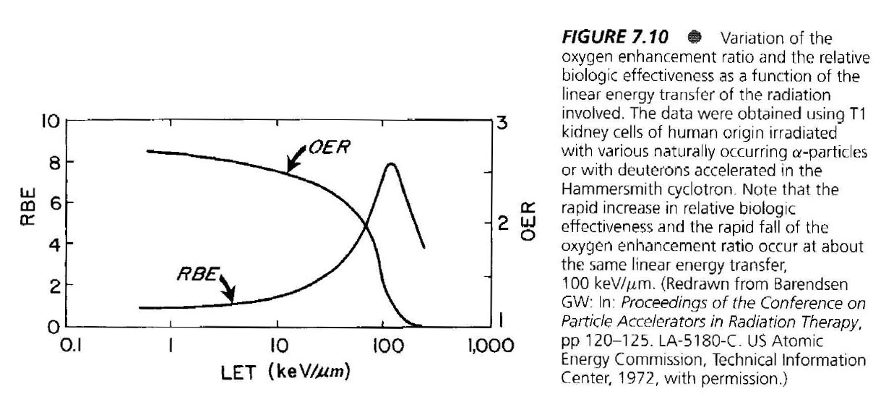
OER and RBE as a function of LET (Fig 7.9)
– virtually mirror images of each other
– rapid increase of RBE and the rapid fall of OER occur at about the same LET, 100keV/μm
10 RADIATION WEIGHTING FACTOR
– simpler way to consider differences in biologic effectiveness of different radiations
– Equivalent dose = the absorbed dose * radiation weighting factor
– Gy : unit of absorbed dose
– Sv (Sievert) : unit of equivalent dose
– weighting factor : chosen by ICRP
– 1 (low-LET; x-ray, γ-ray, electron) ∼ 20 (neutron, α-particle)