Historical perspectives
- Recombinant DNA technology
- DNA by James Watson and Francis Crick in 1953
- First successful cloning experiment by Stanley Cohen, E.coli with plasmid having antibiotic resistance
The structure of DNA
- Double helix is held together by hydrogen bonds between base pairs.
- RNA and DNA
- Unlike DNA, which is located primarily in the nucleus, RNA is found throughout the cell
- Within the nucleus, RNA is concentrated in the nucleoli, dense granules attached to chromosomes
Transcription and translation

The genetic code
- Triplet mRNA sequences specify each of the amino acids
- initiation codon (AUG) represents the “start” signal for protein synthesis
- UAA, UAG, and UGA: termination codons that terminate translation
- Redundancy: single-base change in RNA does not necessarily change the coded amino acid.
[Table17.1 codes for amino acids]
Amino acids and proteins
- Each three-dimensional shape is unique to the amino acid sequence-> key to function
Restriction endonucleases
- Grouped into three categories: types I, II, and III (m/c used: type II)
- scan the DNA molecule, stopping if they recognize a specific nucleotide sequence (palindromic sequence)
- ex. EcoRI, BamHI, and HindIII: recognition sequence -> sticky ends [Table 17.3]
- Fig 17.5, EcoRI

- EcoRI recognizes the sequence 5′ GAATTC 3′; the complementary strand is also 5′ GAATTC 3′.
- “sticky” ends are extremely useful in making recombinant molecules because they rejoin only with complementary sequences.
Vectors
Self-replicating DNA molecule that has the ability to carry another foreign DNA molecule into a host cell
- Plasmids, bacteriophages, bacterial artificial chromosomes (BACs), and viruses
- Plasmids: the simplest bacterial vectors
- circular DNA molecules that can exist and replicate inside a bacterium, independent of the host chromosome
- Bacteriophage (λ)
- Virus that infects bacteria, most commonly used as a cloning vector
- 2 advantages
- Infect host at a much higher efficiency than a plasmid
- Accommodate a larger range of DNA fragments (up to 24,000 bp)
- Bacterial artificial chromosomes (BACs)
- a type of plasmid with sequences encoding self-replication while maintaining a low copy number, carrying very large fragments of DNA
- less prone to recombination events
- Viruses
- Viral infection of mammalian cells has proved to be an effective and efficient method for delivering and stably expressing a gene of interest (GOI)
- 3 types of viruses for gene transfer
- Retroviruses (RNA virus), adenoviruses (DNA virus), Adeno-associated viruses (AAV)
Libraries
- Genomic library: a compilation of DNA fragments that make up the entire genome
- For “shotgun” DNA sequencing: By using this sequence as a probe, overlapping clones can be identified and then sequenced to ultimately develop a “contig,” which represents a contiguous DNA sequence for a portion of a chromosome.
- cDNA library: DNA that is complementary to the mRNA and therefore includes only the expressed genes of a particular cell
- made in either plasmids or bacteriophage λ
- Expression library: screened by oligonucleotide probes or by an antibody that recognizes the protein of the GOI
Hosts
- Recombinant DNA molecules can be constructed and manipulated to some extent in the test tube, but amplification and expression ideally require a host
- E.coli
- m/c used organism, single chromosome consisting of about 5 million base pairs
- episomes: circular DNA molecules containing only a few thousand base pairs
- Yeast
- a wide array of mutants that are sensitive to ultraviolet or ionizing radiations -> study of the genes responsible for radiosensitivity and radioresistance
- similar cell-cycle machinery of all eukaryotes -> studying for cell-cycle control
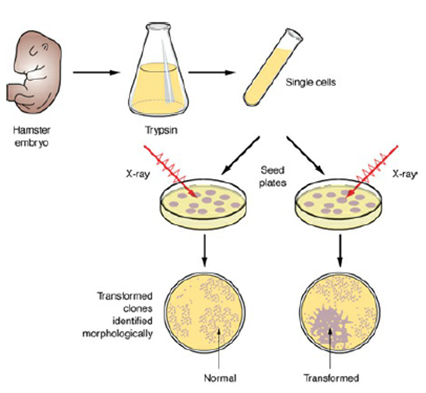
Fig 17.8
- Mammalian cells
- 1. Short-term explants of cells derived from rodent or human embryos with a limited life span
- Hamster embryo cells, Rat embryo cells, Human skin fibroblasts, Human foreskin cells, Human embryo cells
- 2. Experimental systems include established cell lines that have an unlimited lifespan
- Immortal: particular passage can be used over a long period of time and maintained in banks of frozen cells
- ex. BALB/C-3T3 cell line and the C3H 10T1/2 cell line (mouse embryos)
- 1. Short-term explants of cells derived from rodent or human embryos with a limited life span
DNA-mediated gene transfer
Techniques to bypass natural barriers
- Microinjection
- Calcium phosphate precipitation
- Cells take up DNA relatively efficiently in the form of a precipitate with calcium phosphate
- Cationic lipids
- Cationic lipids offer some of the highest transfection efficiencies
- Electroporation
- useful for cells that are resistant to transfection by calcium phosphate precipitation
Agarose gel electrophoresis
- Purpose: to separate pieces of DNA of different size
- DNA negatively charged
- distance migrated is directly related to DNA size.(Fig 17.12)
PCR
-
- enzymatic amplification to increase the number of copies of a DNA fragment
- Taq polymerase: thermostable
- PCR-mediated site-directed mutagenesis
- a technique used to create mutations such as nucleotide replacements, insertions, or deletions at a desired location in the gene or its flanking sequences to investigate the relationship between gene sequence and gene function
- two complementary oligonucleotides containing the mutation of interest are used as the primers for PCR
Genomic analyses
- Concept of personalized medicine, i.e. BRCA1 mutation of breast ca
- most of the mutations identified in cancer genomes are“inactionable,” meaning that there is not a specific therapy targeting the mutation
- most of the mutations identified do not necessarily have a clear impact on radiosensitivity or radioresistance

Fig 17.15
Mapping
- Contiguous mapping
- Mapping: determination of the physical location of a gene or genetic marker on a chromosome
- Contiguous mapping: alignment of sequence data from large, adjacent regions of the genome to produce a continuous nucleotide sequence of a region of a chromosome DNA sequence analyses
- Physical marker: restriction fragment length polymorphisms
- DNA sequence analyses
- Sanger method (dideoxynucleotide chain termination method)
- Recent: automated sequencing
- Latest: NGS (next generation sequencing) or deep sequencing
- sequencing of millions of small fragments of DNA in parallel
- sequence information stitched using bioinformatics programs
- Polymorphisms or Mutations
- DNA polymorphism from point mutations, deletions, or insertions, or tandem repeats
- Detected by Southern blot analysis, PCR-RFLP (polymerase chain reaction–restriction fragment length polymorphism)
- DNA polymorphism from point mutations, deletions, or insertions, or tandem repeats
- Comparative genome hybridization (CGH)
- Tumor and reference (normal) DNAs are fragmented and amplified with random primers and nucleotides labeled with Cy5 and Cy3
- two samples are mixed hybridized to a DNA microarray of cloned fragments containing cDNAs
- The microarray is scanned, and the ration of Cy5 to Cy3 fluorescence is calculated for each spot on the microarray
- Spots with higher Cy5 to Cy3 compared to baseline represent amplifications, and spots with lower Cy5 to Cy3 represent deletions.
- The genes residing in these regions are then identified in a human database to generate potential oncogenes or tumor suppressors.
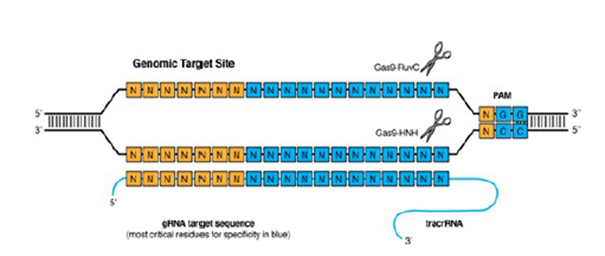
Gene knockout strategies
- Clustered Regularly Interspaced Short Palindromic Repeats (CRISPR) and CRISPR Associated (Cas) Protein
- In lower eukaryotes, short interspersed sequences (approximately 20 base pairs) from viral infections or plasmids serve as a reminder of a previous infection.
- Requires a Cas nuclease (Cas9) and a guide RNA (gRNA) to the target sequence of choice
- Cas9 nuclease cuts both DNA strains, generating double-strand breaks which are defined by 20-nucleotide “target” sequences within the CRISPR RNA (crRNA)
- gRNA contains a tracrRNA (trans-activating crRNA) that is necessary for nuclease activity
- Homologous Recombination to Knockout Genes
- Homologous recombination: eukaryotic cell to repair damage to one chromosome with the DNA from the homologous sister chromosome acting as a template; can be used to selectively delete or alter the endogenous gene in a cell line (Fig 17.7)
- Knockout Mice
- Using homologous recombination, one copy of a GOI is deleted in mouse embryonic stem (ES) cells
- The resultant chimeric mice that are heterozygous for GOI in their gametes are bred to generate male and female GOI heterozygous mice. The heterozygotes are subsequently bred, and of their offspring, one in four should be homozygous knockouts for GOI.

Fig 17.18
Gene expression analysis
- Northern blotting: RNA, rarely not used today due to RT PCR
- RNA Interference (RNAi): gene silencing
- short-interfering RNAs (siRNAs, transient) or short-hairpin RNA (shRNA, long-term gene inactivation)
- Short double-stranded RNA molecules are transfected into a cell -> Cellular RNA degradation machinery incorporates the siRNA to form the RNA-induced silencing complex (RISC) -> selectively recognize the complementary sequences on target mRNAs -> RISC cleaves the mRNA, leading to degradation and a functional loss of protein expression
- Reverse transcription polymerase chain reaction
- RNA purified from cells incubated with a reverse transcriptase (small amount of RNA is possible <- Limitation of Norther blotting)
- Quantitative Real-Time Polymerase Chain Reaction
- possible to accurately quantify RNA from very small amounts of a starting sample
- Promoter Bashing
- Very common use of biologic reporters
- promoter is dissected to determine which region is responsible for an interesting activity (e.g., as induction during ionizing radiation or hypoxia)
- Chromatin Immunoprecipitation (ChIP)
- transcription factor interactions with a target promoter in the native chromatin environment
- to correlate the DNA-binding activity of a given transcription factor with corresponding changes in the surrounding chromatin environment and gene expression in cells exposed to different hormones, cellular stresses, and differentiation programs
- Protein–DNA Interaction Arrays (Chromatin Immunoprecipitation-Chips)
- used primarily to map transcription factor binding and histone modification across the entire yeast genome
- human genome: focus on more specific regions either cloned promoter fragments or CpG islands
- correlation of transcription factor binding, chromatin structure, and gene expression.
- Microarrays to Assay Gene Expression
- Cellular RNA is reverse transcribed, amplified with modified nucleotides that allow fluorescent detection, and hybridized to an array of sequences corresponding to the genes in an organism
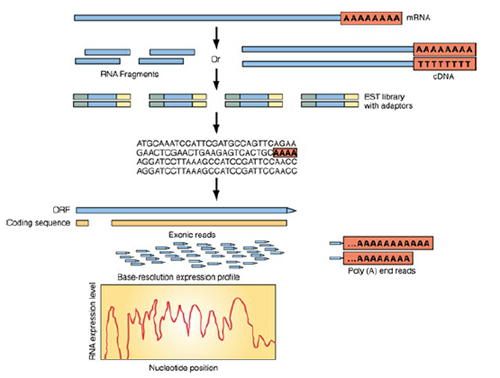
Fig 17.22
- RNA-Seq to Assay Gene Expression
- very precise information on transcript structure as well as transcript number.
- Chromatin Immunoprecipitation-Seq
- to identify the sequence specific binding sites of chromatin-associated proteins and transcriptional regulatory proteins (genome-wide protein–DNA interactions with high resolution)
Protein analysis
Western blotting
- A method to detect the presence and abundance of a specific protein within a mixture of proteins
- Antibody to recognize the protein of interest (POI)
Antibody production
- Monoclonal Ab: made by injecting either mouse or rats with the POI -> B lymphocytes fused to a specific tumor cell line to create hybridoma -> screened for antibody production and specificity.
- Polyclonal Ab: animal is injected with the POI and adjuvant and then bled. The antibodies can then be purified out of the blood.
Antibody ProductionImmunoprecipitation
- to detect specific protein–protein interactions
- antibody against a specific protein + target -> immune complex -> captured by addition of proteins A and G agarose for isolation and purification
Far Western Blotting
- Another useful method for probing protein–protein interactions
- Instead of using an antibody to detect a specific protein, purified recombinant protein is used to probe a membrane of electrophoresed cellular protein
Fluorescent Proteins
- GFP from the jellyfish Aequorea coerulescens
- RFP from Discosoma reef coral
- A common practice is to fuse GFP to a POI and RFP to another POI to simultaneously monitor intracellular protein activity either in cells in culture or in mice
- fluorescence resonance energy transfer (FRET): to observe the dynamic interactions of proteins in the cell
Two-Hybrid Screening
- A powerful method for identifying factors that interact with a given protein
- The cDNA for a POI is cloned into an expression vector as a fusion with the DNA-binding domain of a transcription factor (GAL4-DBD)
- widely used to identify proteins that are involved in DNA repair complexes and radiation-induced signal transduction.
Split Luciferase Complementation Assay
- splitting a reporter gene such as luciferase into amino (N−) and carboxyl (C−) fragments
- ligated to proteins that are known to interact or unknown to interactreflects the protein–protein interactions
- performed in mammalian cells both in cell culture as well as in tumors in vivo
- effect of the cellular microenvironment can be studied
Proteomics
- Two major uses for cancer therapy
- to detect specific secreted proteins or fragments in the serum of cancer patients that reflect a disease state or response to therapy
- to determine the protein profile of tumor cells to aid in directing therapy
Two-Dimensional Electrophoresis
- isoelectric focusing (IEF)
- Every protein has a distinct electrochemical charge that is a result of its unique amino acid composition
- Proteins can be separated by charge in tube gels or paper strips